- Published: 15.10.2026.
Urban planning project to speed up projects of national, local importance

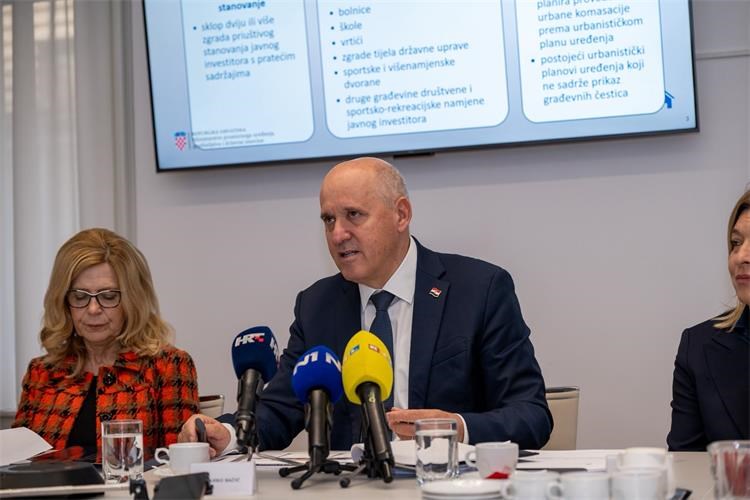

Hina - Construction, Physical Planning and State Assets Minister Branko Bačić presented a regulation on urban planning projects on Thursday, aimed at accelerating projects of national and local importance, including affordable housing, kindergartens, schools, hospitals and other projects of public interest.
He said the urban planning project had been introduced primarily to promote affordable housing and would help local government units and the state real estate agency APN move quickly to construction under the new procedure.Schools, kindergartens, hospitals, sports halls and other buildings financed by public investors would also be built more quickly because, as Bačić said, the urban planning project combines three procedures into one. Previously, an urban development plan had to be adopted first, followed by an environmental impact assessment as part of obtaining a location permit, before the location permit itself could be issued.
Urban land readjustment is also being reintroduced after 12 years. It can be carried out only in areas where it is provided for in spatial planning documents. "There can be no urban land readjustment without a local government unit," Bačić said.
Asked whether the state could carry out urban land readjustment and build its own projects even if a local government unit opposed them, the minister said the local authority's consent was required. Asked whether this meant a city or municipality could block a national project, he reiterated that consent would be sought.
"We are preparing a national spatial development plan. Once it is implemented, it will define facilities of national importance. Local government units will take part in the process, but the national spatial development plan will be decisive for the adoption and implementation of such projects," Bačić said.
Urban planning projects for developments of national importance will be adopted by the government, while those for projects of local importance will be adopted by the representative body of the relevant local government unit.
Bačić also recalled that the National Housing Policy Plan envisaged the construction of 10,000 housing units by 2030.
"If we make no changes to spatial planning, neither we nor local government units will meet that target. That is why the issuing of building permits for affordable housing will be accelerated, and an urban planning project is needed to make that possible," Bačić said.
He added that the European Commission had proposed measures to speed up procedures for affordable housing nine months after Croatia had done so.
"What we said in March, the Commission proposed to member states in December, and by October we already have a solution to speed up affordable housing projects, as well as other projects of public interest," he said.
Bačić also presented a regulation on a spatial planning information system, which he described as one of the most integrated systems and platforms in the EU for the full digitalisation of spatial planning and construction.
An electronic spatial planning inspectorate is also expected to become operational early next year.
"The system will directly notify municipal wardens and building inspectors of every case of illegal construction, without anyone having to visit the site, because continuous monitoring of satellite imagery in real time will make it possible to identify any change to a plot of land," he said.
He added that almost three million building permits, occupancy permits and other permits had been stored digitally, with 110 million views recorded each month. Under the e-permits system, the average wait for a building permit for a family house is around 10 days.
Under a proposed 2027 annual plan for the management of state-owned real estate and movable assets, the state expects to generate €78 million in revenue.
Bačić said the key planned results for next year concerned the management of real estate of strategic importance to the state.
For properties not considered strategically important, the state plans to invest €23.1 million in 532 properties next year and make 300 flats available for the affordable housing programme and the Statileo programme.
The plan also includes signing 600 property sale and purchase contracts, 680 rental agreements and 208 contracts covering building rights, easements, allocation for use or exchanges. It also envisages 142 contracts to donate properties for public policy needs and development projects, as well as launching 151 public calls for the disposal of state-owned property.
An urban planning and architectural competition for the former Vjesnik tower in Zagreb is also planned for next year.
Asked about the construction of a new Maksimir stadium in Zagreb, after the Italian architects who won the competition published new images of the proposed design, Bačić said the state commission responsible for public procurement appeals should first rule on the complaints received.
"The government and the City of Zagreb, which acted as the contracting authority, reserve the right to make a decision on the entire procedure," Bačić said.