
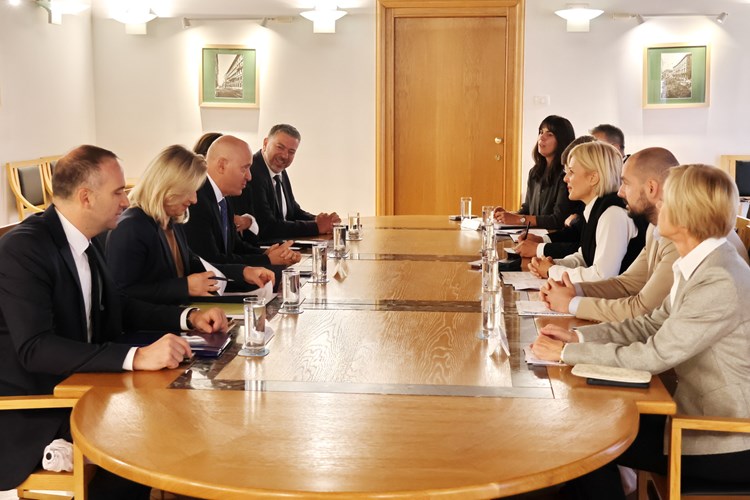
On a meeting with Mayor Iva Rinčić and her associates, a discussion took place on the issues of affordable housing and state assets management. The first topic was the status of the HŽ skyscraper - an object previously donated to the University of Rijeka for the purpose of converting it into a student dormitory and a youth hostel, but since the project had not been carried out in the contracted timeframe, the skyscraper was returned to the state.
“Since the object is owned by the state, we will define its status in cooperation with the Ministry of Education. If it is not used for the purpose of converting it into a student dormitory, it will be converted into state apartments intended for protected tenants or for affordable housing, in accordance with the National Housing Policy Plan the Government adopted in March,” Minister Bačić announced. He added that there are other spaces in Rijeka suitable for the construction of a new student dormitory, in which case the skyscraper would be repurposed for housing care.
“Our contribution to affordable housing is also evident in encouraging the construction of student dormitories, since every student moving into a dormitory leaves an apartment available for affordable rental,” the Minister stated. He also added that the Državne nekretnine company is adapting approximately 30 apartments for protected tenants and affordable housing in Rijeka.
Mayor Iva Rinčić said that the meeting with Minister Bačić and his associates was short but very productive.
“We discussed the important issue of affordable housing and the possibilities of activating some real estate owned by the state - primarily the skyscraper in Ulica Prvog maja. We also touched upon other topics and established the bases to continue our cooperation, taking into consideration the plans of the City. I believe this is only the beginning and that we will continue the dialogue with the state with the aim of improving the quality and availability of housing in the city of Rijeka,” the Mayor said.
The second topic of the meeting was the state-owned land in Orehovica, where a city compost facility is planned for construction. “As the competent ministry governing state assets, we agree with this proposition and we would like to implement is as soon as possible in cooperation with the City and County,” the Minister stated.
In continuation, the conversation also focused on the new legislation package currently open for public consultation - the Physical Planning Act, the Building Act and the Act on Energy Efficiency in Building Construction, as well as the Affordable Rental Programme, whose public consultation has already finished, and the Affordable Housing Act, which is in development.
“We have come into agreement with the City that it is precisely these acts and sublegal regulations that could provide our fellow citizens, both in Rijeka and beyond, with a good-quality and affordable housing,” Minister Bačić concluded.
Proposal of the Spatial Plan of the Exclusive Economic Zone in the Adriatic Sea
Today, on the premises of the Faculty of Maritime Studies in Rijeka, the Proposal of the Spatial Plan of the Exclusive Economic Zone in the Adriatic Sea was presented.
The Plan is a strategic document which, for the first time, comprehensively defines maritime spatial planning of Croatia, with an emphasis on natural resources management, marine ecosystem protection and economic activity development in accordance with European and international standards.
“Our activities to establish sovereign rights in the Adriatic have been present for a long time. This Plan encompasses nearly 24,000 square kilometres of the Adriatic Sea, and such a large space offers numerous possibilities for economic development. We are guided by the notion that this part of the Adriatic should not be a burden to development, but a resource for progress,” Minister Bačić said.
The Spatial Plan entails programme starting points and a framework of activities in the field of aquaculture and fisheries, the exploration and exploitation of hydrocarbons in the northern Adriatic, maritime traffic, military training, the positioning of submarine cables and pipelines, as well as sites for the conservation of nature, biodiversity, underwater cultural heritage and scientific research.
“The Plan is aimed at encouraging economic development, maritime navigation and fisheries, managing underwater resources, but it is equally important to determine how we will govern this space while preserving it. I believe such balance is achieved. By now we have held three presentations, this one being the fourth one, we have heard the positions of scientists, experts and all those who think it is important to manage this marine space efficiently. As the state managing approximately half of the Adriatic, we have created legal and economic conditions for sovereign governance over the space,” Minister Bačić concluded and stated that the adoption of the Plan’s Proposal in the Croatian Parliament next year will conclude long-lasting efforts of the Republic of Croatia to gain jurisdiction over the Adriatic.
The Proposal of the EEZ Spatial Plan was further presented by Director of Institute for Spatial Development Bojan Linardić, who showed the participants the key objectives of the document. Public consultation was opened on September 1, and you can participate by the end of the day.