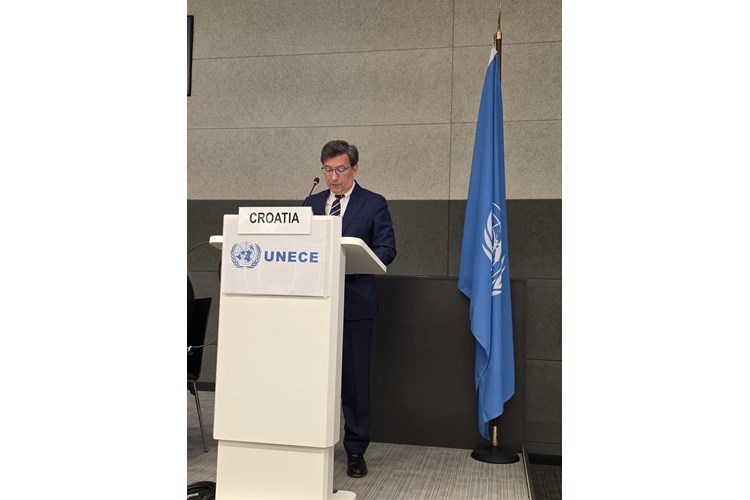
State Secretary Željko Uhlir, Director of Directorate for Housing Policy Implementation, Housing Quality and Public Utilities Economy Tomislav Jukić and Advisor to the Minister Nevena Bjeliš participated in the 86th session of the UNECE Committee on Housing, Urban Development and Land Management held from October 8 to 10 in Geneva, which also included the Ministerial Meeting on Housing Affordability and Sustainability.
The session which gathered more than 30 ministers and high-level government representatives of the Member States focused on the worldwide housing crisis and housing affordability, emphasising current challenges and strategic priorities for solving the housing crisis.
In his speech, State Secretary Uhlir pointed out that, since the last ministerial meeting on housing, the Republic of Croatia faced two devastating earthquakes which destroyed infrastructure and private property, leaving deep marks on Croatian citizens who lost both their homes and a sense of safety, stability and belonging.
Croatia opted out for the “Built Back Better” principle
“The reconstruction in Croatia is based on the “Build Back Better” principle. Our goal is not only to repair buildings, but to build more resilient, safer and more energy efficient homes, in accordance with the 2030 Agenda and the Sustainable Development Goals.
Each reconstructed apartment or house represents much more than just a building - it is a home restored, a hope renewed and a place where families can build their future. Allow me to express my gratitude to our international partners - the United Nations and agencies, the European Union, and all other states and organisations which showed solidarity and support. Your help is not just material - it is an expression of unity, multilateralism values and the belief that no one should be left aside,” State Secretary Uhlir pointed out, adding that global challenges did not spare Croatia either; rising prices of energy sources, inflation and labour shortages directly affected the price of residential real estate - resulting in a 54% increase over the last four years and significantly reducing housing affordability.
“Affordable housing has become one of the key developmental and social issues of our time. In response to these challenges, this year the Government of the Republic of Croatia adopted the National Housing Policy Plan until 2030, the first strategic document of its kind in our country. The National Plan relies on four state levers to establish a sustainable system for affordable housing: tax, financial, land, and ecological and energy. It represents a long-term framework for just, sustainable and inclusive housing, in accordance with international obligations and universal values of the United Nations. Because a home is not just a roof over one’s head. A home is the foundation of safety, a source of identity and the starting point for achieving all other human rights. It is, as emphasised by the UN-Habitat as well, essential for sustainable communities and for the future of mankind,” State Secretary Uhlir emphasised.
The UNECE session directly addressed the results of the 2024 in-depth analysis of the situation in 32 UNESCE Member States (EU + Island, Norway, Switzerland, the United Kingdom and Serbia), identifying main drivers of differences in housing affordability, including demographic changes, regulatory obstacles and economic inequalities. The study also focused on the complex dynamics of apartment supply and demand, with a special emphasis on disproportionate impacts on vulnerable groups. The data showed that over a third of European citizens in the lower 40% of the income bracket suffer from “housing stress” and that many households spend upwards of 45% of their income on housing expenses. The most vulnerable groups are young families, older persons, single-parent households and immigrants.
Highly important international cooperation
This calls for additional public investment and the expansion of the stock of public, community-led and social housing models, as well as fostering private funding through green bonds, sustainability-linked loans, community land trusts or blended finance instruments. It is also necessary to adjust land value taxation to make land policies more equitable and to regulate short term tourist rentals.
UNECE Executive Secretary Tatiana Molcean stated that “by adopting these commitments, Ministers and high-level representatives of UNECE Member States send a powerful message that housing affordability and sustainability are fundamental priorities and that our region stands united in tackling them through international cooperation, multi-level governance, and above all, equity and inclusion”.
Chair of the Ministerial Meeting Martin Tschirren, State Secretary, Director general of the Federal Office for Housing, Switzerland, stated that “without general access to affordable, high-quality needs-based housing, many social and economic problems can arise, affecting different areas of public policy such as education, health, transport and environment. Almost all countries are confronted with a lack of housing in general, and affordable housing and housing construction in particular. This is why international cooperation is so important to share ideas, best practices and insights.”
Prior to the Ministerial Meeting on Housing Affordability and Sustainability, a UNECE conference also took place, where State Secretary Uhlir presented the National Housing Policy Plan of the Republic of Croatia until 2030.
News |
Information