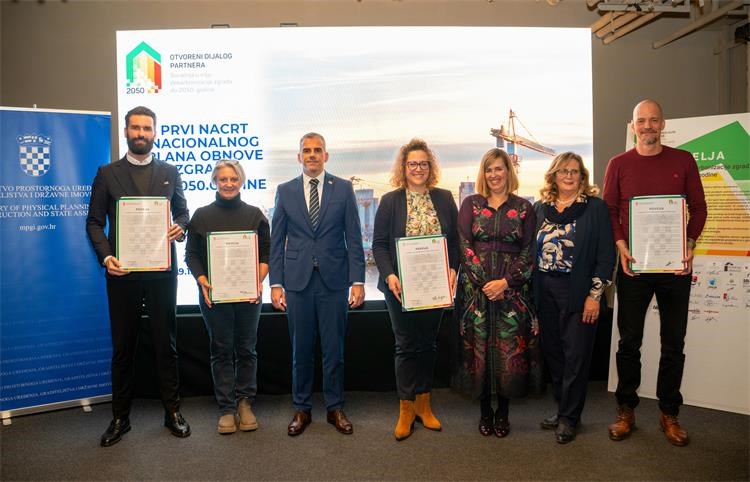
On Tuesday, December 9, 2025, on the premises of Katran Studio in Zagreb, the eight Open Dialogue of Partners was held. The aim was to gather representatives of the central and local governments, academic community, expert public and the construction and energy sector to participate in thematic discussions and interactive presentations.
This year’s dialogue, organised by the Ministry of Physical Planning, Construction and State Assets, focused on the National Building Renovation Plan until 2050, and a Charter on the Decarbonisation of Buildings was signed.
The gathering was opened by Director of Directorate for Energy Efficiency in the Buildings Sector, European Union Projects and Programmes Irena Križ Šelendić. She pointed out that National Building Renovation Plan until 2050 should be adopted by all Member States by the end of 2026, while the first draft should be sent to the European Commission by the end of this year, which is why this was the ideal time for discussion.
“The National Plan is an expert strategic document, an implementing plan which defines specific goals, policies and measures, as well as indicators, that should be achieved,” the Director said.
She also commented on the first projections of necessary investment, which is “extremely demanding” because it entails significant funding for building renovation.
She pointed out that, according to the new Energy Performance of Buildings Directive (EPBD), it is necessary to set thresholds for operational greenhouse gas emissions and maximum permitted primary energy values for new and renovated zero-emission buildings (ZEB), because the construction obligation set for nearly zero-emission buildings (nZEB) will be replaced by the obligation to construct and renovate buildings according to the ZEB standard from 2028. The new EPBD prescribes the obligation to achieve minimal energy performance standards (MEPS) for non-residential buildings, i.e. the requirement that buildings reduce primary energy below the threshold of 16% of worst-performing buildings from 2030, and below the threshold of 26% from 2033.
She added that the adoption of the new Act on Energy Performance in Building Construction is underway. It entered parliamentary procedure, and it prescribes the adoption of the National Plan, which will eventually replace the Long-term Renovation Strategy of the National Building Stock by 2050.
Charter on cooperation aimed at decarbonisation of buildings until 2050 signed
Charter on the Decarbonisation of Buildings has been signed by 89 signatories, including several ministries, the Environmental Protection and Energy Efficiency Fund, the Croatian Association of Heating and Cooling System Manufacturers, the nZEB cluster, the Croatian Green Building Council, the Energy Institute Hrvoje Požar, cities and regional energy agencies, designers, contractors, faculties, professional chambers, building managers and building material manufacturers. This year the Charter was signed by four new partners - FIBRAN d.o.o, GREEN ADVISORY d.o.o., KAMENOVIĆ d.o.o. and VIESSMANN d.o.o. The charters were presented to new signatories by State Secretary Tonči Glavinić.
The Charter supports meeting the energy and climate goals at the national and European level, decarbonisation of the building stock, renovation of existing and construction of nearly zero-emission buildings, with the aim of further reducing greenhouse gas emissions, increasing the share of renewable energy sources, strengthening energy safety and introducing innovation and smart technologies, which enable buildings to contribute to the overall economy decarbonisation. By signing the Charter, continuous cooperation on the development of the Long-term Renovation Strategy of the National Building Stock is encouraged, and the transition to the standard of building nearly zero-emission buildings (nZEB) is promoted.
National Building Renovation Plan until 2050
The National Building Renovation Plan until 2050 was presented, which entails an overview of the national building stock, a plan for a decarbonised building stock by 2050, the renovation of non-residential buildings and the renovation of residential buildings.
The overview of the national building stock was developed based on available data for 2023, and it comprises the share of residential and non-residential buildings, distribution by building type, number and useful floor area of the heated part of the building, distribution of buildings by energy classes, noting that only 9% of buildings had a valid energy performance certificate in 2023. The overview of the national building stock entails the distribution of primary energy consumption, final energy consumption, total greenhouse gas emissions and trends in energy consumption and greenhouse gas emissions from 2020 to 2023, as well as the share of renewable energy sources in final energy consumption.
The National Building Renovation Plan until 2050 was presented as part of an interactive presentation, which included an anonymous poll integrated into the presentation. The poll encouraged the participants to engage and express their opinions based on individual experiences.
The discussion took place through seven poll questions referring to non-residential and residential buildings.
Non-residential buildings
The plan for a decarbonised building stock by 2050 was presented, including the goals of saving primary energy and renovated surface areas of buildings by 2030, 2040 and 2050. With regard to the renovation of non-residential buildings, two possible renovation approaches were pointed out: defining MEPS for the entire non-residential building stock or for a specific building type. In both cases, MEPS are defined for each phase. The first phase, by 2030, requires renovation of 16% of the useful floor area of the heated part of the building whose specific annual primary energy exceeds a defined threshold. The second phase, by 2033, requires renovation of 26% of the useful floor area of the heated part of the building whose specific annual primary energy exceeds a defined threshold. The third phase covers the period by 2040 and the fourth by 2050. In the first two phases it is possible to define MEPS for a specific building type or for the entire building stock, while the last two phases envisage defining MEPS for the entire building stock.
The first poll, on how to rank the importance of obstacles encountered so far, produced the following results. The most significant obstacle is the high cost of equipment and works, followed by administrative procedures, unfavourable cost-effectiveness of investment (considering only energy cost savings as a benefit) and a lack of information among investors. The least significant obstacle is the shortage of workforce, i.e. a lack of knowledge and skills among small contractors.
The second poll, on how to rank the importance of approaches to align MEPS, produced the following results. The most important approach is encouraging deep energy renovation of buildings, followed very closely by determining MPES thresholds for each building type. Ranked third is applying individual renovation measures producing the largest savings, while the least important approach is meeting the minimal prescribed energy performance value of a building below the MEPS threshold.
Further discussion concluded that the importance of meeting the minimal prescribed energy performance value of a building below the MEPS threshold is much greater. The reason is that energy consumption largely depends on the building type, and, in turn, its usage regime. Some buildings are not used all year round, and with lower frequency of use, the cost-effectiveness of investment in energy renovation is also lower.
The third poll, on how to rank the importance of elements of the framework for implementing MEPS, produced the following results. The provision of adaptable financing schemes with incentives to implement deep and comprehensive renovation was ranked the most important, followed by the focus on the renovation of specific type of worst-performing buildings (e.g. hospitals and educational buildings) or types of use (e.g. rental buildings) or building size (e.g. buildings larger than 1,000 m2). Next in importance is upgrading the skills of experts and workers performing energy renovation works and public campaigns on renovation obligations. The least important is the establishment of one-stop shops in local communities.
Further discussion concluded that greater importance should be given to the establishment of one-stop shops. This issue is often viewed from the perspective of residents in large cities, but the situation is different in smaller communities - both in terms of availability of adequate workforce and access to information. There we witness a shortage of experts, which is a prerequisite for the establishment of one-stop shops. Good networking of investors in non-residential buildings is important, since they only require an acceptable financing scheme to meet the goals of building renovation. Rights and obligations are well-known to leading market players, but not so much to smaller ones, which is why public informative campaigns are indispensable.
The fourth poll answers the question which element of the penalty system framework is considered most important. A total of 83% of participants think the most important element is the obligation to develop an energy performance certificate and to implement minimal mandatory energy savings, while the remaining 17% consider that mandatory implementation of measures on a building upon sale, rental, donation or change of use in the cadastre or land registry is more important.
Residential buildings
The renovation of residential buildings is focused on 43% of usable floor area of the heated parts of the worst-performing buildings. In order to develop a national plan for a gradual reduction of specific primary energy consumption of residential buildings by 2050, five scenarios based on renovation categories were analysed. Scenarios S1 with a 60% reduction and S4 with a 30% reduction, as well as an optimised mix of all scenarios, were presented in more detail. Every scenario includes the building area in need of renovation and the amount of investment to implement energy efficiency measures.
The fifth poll, on how to rank the importance of implementing policy measures to reduce the average primary energy consumption of residential buildings, produced the following results. Financial support for the renovation of the worst-performing buildings, vulnerable population groups, support schemes based on achieved savings and deep renovation are considered the most important. Next in importance are technical support for the establishment of one-stop shops, the development of renovation passports and data gathering on all completed renovations, from minor individual measures to deep renovations. Other policies and measures prepared and implemented by energy suppliers are ranked last.
Further discussion concluded that financial support is important, but it is also important to be open to new financing models and private investment. The discussion also highlighted that the obligation cannot rest solely on the end user, but also on suppliers, for instance by introducing favourable decarbonisation tariffs or by developing innovative mechanisms for trading of energy savings. It also emphasised the need to educate end users, provide technical support and introduce schemes that encourage deep renovation, such as tax refunds or covering the costs of developing energy performance certificates. The latter further contributes to data gathering on completed renovations, which is important because energy renovations carried out using private funds are not recorded, even though they contribute to achieving the goals.
The sixth poll, on which level of renovation is most needed to achieve the goals in the peirod up to 2030, found that participants prioritised comprehensive renovation, which includes energy and seismic renovation. Deep renovation ranked second, followed by district renovation, then integral renovation, energy sharing and energy communities, and individual measures.
Further discussion stated positive experiences regarding district renovation as a practical solution and a pathway to achieving the goals at a lower cost per unit area, which also addresses urban planning. The discussion stated that individual measures lead to the fastest achievement of goals, but that deep and integral renovations are the only viable options in the first period, when the duration of project preparation and implementation, and administrative obstacles, are taken into account. Building managers and local self-government units have significant responsibility for achieving the goals. The policies and measures of suppliers will have a more substantial impact once remote systems are decarbonised, and particularly once the potential of geothermal energy sources is unlocked.
The seventh poll, on ranking the interest for installing photovoltaic systems by 2030, produced the following results. Considering the current situation, 59% of participants think that by 2030 we can expect installed photovoltaic systems in 15% of households. Furthermore, 32% of participants think it is more realistic to expect 5% of households with photovoltaic systems, and the remaining 8% think that 20% of households will have photovoltaic systems by 2030.
Further discussion concluded that a lack of interest for installing photovoltaic systems is nevertheless expected due to upcoming abolition of preferential purchase price for electrical energy and administrative obstacles such as connection approvals and long waiting times for decisions, in addition to the significant increase in the price of photovoltaic systems.
The consultations conducted as part of the open dialogue of partners confirmed a high level of stakeholder consensus on key technical, regulatory and implementing challenges related to the National Plan draft. Obstacles that hinder renovation implementation were identified, together with a clear need for financial and technical support mechanisms, the priority role of deep and comprehensive renovation, especially in the first period up to 2030, as well as the importance of an efficient renovation management model at the level of buildings and local communities and expected trends in the development of renewable energy sources.
A comparison of the consultation results with the main requirements of Directive (EU) 2024/1275 (EPBD) confirms that it is necessary to establish a stable, financially predictable and technically feasible pathway towards reducing primary energy consumption and renovating building in the period up to 2050.
In conclusion, a faster pace of all activities related to further development and adjustment of the National Plan is expected during 2026. Simultaneously, communication and coordination with a broader group of stakeholders is anticipated to intensify in order to shape and improve policies and measures necessary to achieve the goals by 2050. In addition, a series of legislative activities related to fully transposing the EPBD is expected as early as in the first half of 2026, which will directly affect the content and structure of the final National Plan.
The National Building Renovation Plan until 2050 has been developed in collaboration between the Ministry of Physical Planning, Construction and State Assets and the Energy Institute Hrvoje Požar.
News |
Information