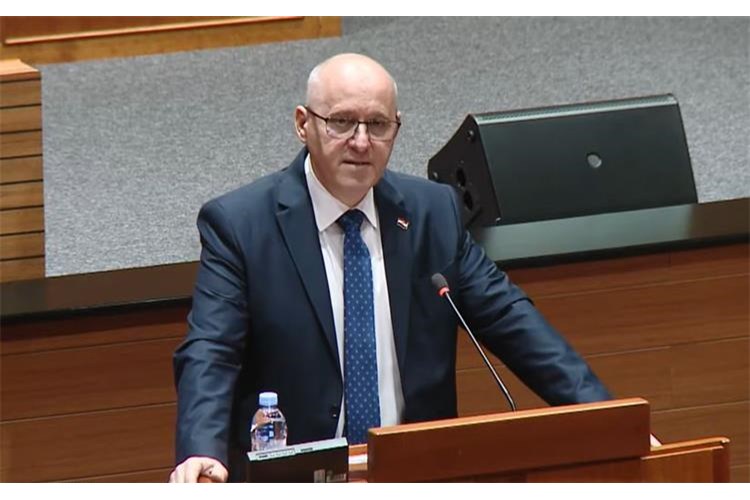
At today’s first reading, Members of the Croatian Parliament discuss the Proposal of the Affordable Housing Act, presented by Deputy Prime Minister and Minister of Physical Planning, Construction and State Assets Branko Bačić on behalf of the proponent. The adoption of this act is envisaged by the National Housing Policy Plan of the Republic of Croatia until 2030 with the aim of ensuring affordable housing, i.e. increasing the supply of affordable apartments available for lease and purchase.
Minister Bačić is accompanied by State Secretary Željko Uhlir and Director of Directorate for Housing Policy Implementation, Housing Quality and Public Utilities Economy Tomislav Jukić.
The Affordable Housing Act is an umbrella legislative framework developed based on the National Housing Policy Plan of the Republic of Croatia. Measures stemming from the housing policy entail increasing the housing supply, regulating the rental market and reducing regional differences.
Over the next four years, the state plans to build and reconstruct 20,200 apartments and family houses, whereby 8,000 of them refer to new apartments built by the Agency for Transactions and Mediation in Immovable Properties (APN), and 9,000 apartments refer to vacant apartments activated for the purpose of affordable housing.
“This is a process which cannot ensure affordable housing instantly, but we are confident that by realising the act on building maintenance, real estate tax, housing care in assisted areas, apartment lease and a set of acts from the field of physical planning, we will ensure more residential housing units, activate vacant housing units and build new ones, thus stopping growing real estate prices,” Minister Bačić said while presenting the Proposal of the Affordable Housing Act to Members of the Parliament.
Subsidies or housing care will be provided to citizens with lower income, people under the age of 45, families with children, people in shortage occupations, people involved in precarious work, active military personnel, police officers, state and public officials and employees in shortage occupations, people over the age of 65, citizens with limited access to healthcare and others who need housing support.
The prerequisite is that they do not own adequate residential real estate. In buildings built for the purpose of affordable housing, 50% of housing units will be for sale and 50% for lease, at prices based on the costs, except in buildings with less than 10 apartments, where all apartments will be intended for affordable rentals.
For the first time, the concept of a micro housing unit is introduced into housing construction. It refers to smaller-sized units intended for transitionary periods of individuals resolving their housing situations.
“Croatia, and the European Union as well, faces the challenges of affordable housing. In this context, for the first time, the European Commission has appointed a commissioner for affordable housing and in December last year it adopted the European Affordable Housing Plan. In late March 2025, Croatia adopted the National Housing Policy Plan, which analyses the current situation and challenges, and sets a framework for providing Croatian citizens with affordable housing,” Minister Bačić pointed out.
“Since Croatia entered the European Union, our real estate has raised interest among foreign buyers, and some citizens have recognised investment in apartments as a way of preserving property and increasing its worth. Many have decided to use their real estate for short-term rentals or other business activities, which is why today approximately 40% of real estate is not used for housing, while as much as 25% is vacant. These are the key reasons for adopting the new act, whose measures encourage better access to housing, construction of new housing units and activation of existing ones,” Minister Bačić clarified.
The new Act increases the role of self-government units, and for the first time, the field of housing includes counties as well, which will be able to participate in providing housing care. Local and regional self-government units participate in the implementation of the Act by establishing public institutions, developing local housing programmes, providing land, co-financing construction and amending spatial plans. They monitor citizens’ needs, collaborate with APN and may exempt projects from paying utility charges and facilitate their implementation otherwise.
The Act envisages the development of the national Affordable Rental Programme, developed by APN, while local and regional self-government units will develop their own programmes. This ensures affordable housing through the construction of such buildings in urban, peri-urban and rural settlements, it defines locations, citizens’ needs, implementation measures, available resources and plans to build apartments to rent or purchase.
Other implementation models entail subsidies for the acquisition of first residential real estate and affordable rental programmes, building reconstructions, construction of family houses in urban, peri-urban and rural settlements and activation of vacant residential properties for the purpose of improving access to rental apartments without the need for building new ones. The mechanism is conducted by APN, with financial support from the Republic of Croatia and possible involvement of the local level.
News