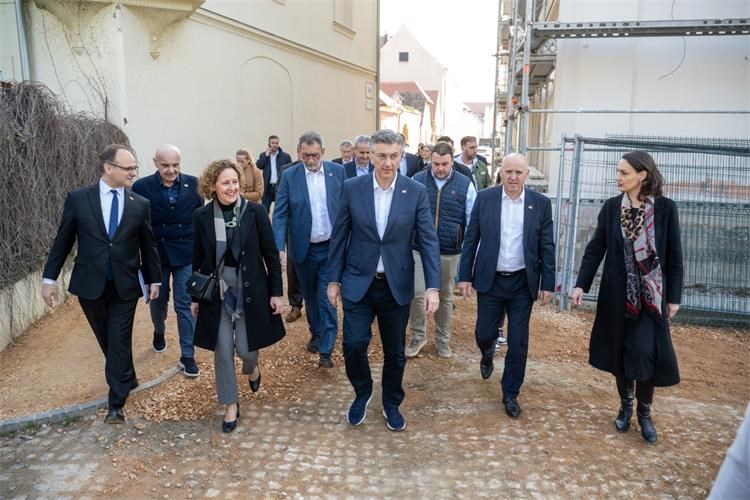
Hina - Prime Minister Andrej Plenković, accompanied by a few ministers, on Saturday visited several post-earthquake reconstruction sites in Zagreb, and underscored that a total of €4.65 billion has been spent on the reconstruction following the Zagreb and Petrinja earthquakes.
On the eve of the sixth anniversary of the Zagreb earthquake, the Prime Minister and his team visited five reconstruction sites where €330 million has been invested.
“Reconstruction has required enormous investments in healthcare, culture, education, public infrastructure and private buildings. So far, €1.6 billion has been invested in healthcare alone,” Plenković said.
The full reconstruction of the Zagreb Clinical Hospital Centre (KBC Zagreb) is expected to be completed by the end of 2027. He added that around 6,000 employees will work in completely improved conditions, while patients will receive care at a very high standard, describing the facility as essentially a new hospital.
Health Minister Irena Hrstić noted that the government has invested €3 billion in healthcare over the past decade, and said the new lung clinic within KBC Zagreb represents a modern centre of excellence in pulmonology. She added that healthcare funding has been steadily increasing, with significant long-term growth.
Hrstić noted that the healthcare budget has been increasing every year, with an average growth of 27% over the past 25 years and 14% annual growth over the past decade. She said this reflects the government’s commitment to improving healthcare, quality of life, and treatment outcomes.
Academician Miroslav Samaržija, head of the Lung Disease Clinic, recalled that the building had to be evacuated three times after the earthquake six years ago and said the new facilities are entirely new rather than renovated.
KBC Zagreb Director Fran Borovečki said total investments in the hospital will exceed €630 million by 2027, marking the largest investment in the institution’s history.
Plenković also said the overall reconstruction should be completed by 2030, noting the complexity of organising such a large-scale process and securing funding and construction capacity. He compared Croatia’s reconstruction timeline with long-term recovery efforts in other countries, such as Italy.
Construction Minister Branko Bačić said the reconstruction covers 14,500 locations and around 55,000 housing units affected by both earthquakes. He added that the goal is to complete all buildings marked as unsafe (“red labels”) by the end of 2027, with over 450 replacement homes already built.
News |
Information