Hina - Members of the Croatian Parliament on Tuesday backed a spatial plan for the Adriatic exclusive economic zone (EEZ), a strategic document governing the use of Croatia's maritime area that does not envisage any new hydrocarbon extraction fields.
The plan is the first comprehensive framework for spatial planning of Croatia's maritime area, focusing on sustainable resource management, marine ecosystem protection and economic development in line with European and international standards.
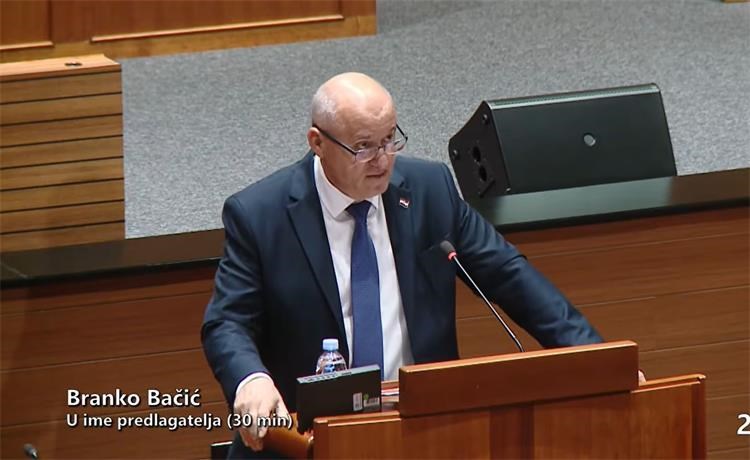
Deputy Prime Minister and Physical Planning Minister Branko Bačić said the EEZ covers 24,000 square kilometres. Together with internal waters and the territorial sea, Croatia's maritime area is roughly equal in size to its land territory.
He noted that Croatia, which declared the EEZ in 2021, enjoys sovereign rights over natural resources and economic activities in the zone, though not full sovereignty as in its territorial waters or land territory.
The plan covers aquaculture, fishing grounds, hydrocarbon exploration and production, submarine cables and pipelines, maritime transport, military activities, nature conservation, protected marine areas, underwater cultural heritage and scientific research.
Bačić stressed that hydrocarbon exploration and production would continue only at the existing Izabela, North Adriatic and Marica fields, with no new extraction fields planned.
Fishing restrictions would remain in the Jabuka Pit.
He said the plan sought to balance economic development with environmental protection, ensuring the Adriatic remained one of the world's most attractive seas while supporting shipping, fisheries and aquaculture.
The document was prepared by the Croatian Institute for Spatial Development, while the environmental impact assessment was conducted by Ires Ecology. Consultations were also held with Slovenia and Italy.
Opposition and ruling-party MPs alike supported the plan, particularly its exclusion of new hydrocarbon fields.
Speaking for the Social Democratic Party, Matej Mostarac said Croatia, as a maritime country, should treat planning of its sea area as seriously as land-use planning.
Bridge MPs welcomed the plan but stressed that effective monitoring and enforcement would be crucial. They warned about overfishing by Italian vessels and called for stronger protection of Croatian fishermen and more effective EEZ surveillance.
We Can! also backed the proposal, urging the designation of additional “no-take” zones across the Adriatic where fishing would be prohibited.
Anka Mrak Taritaš (GLAS) and Damir Barbir (Centre) described the plan as an important step, saying Croatia must have a clear vision for its maritime area, while Ivan Dabo from the ruling Croatian Democratic Union (HDZ) said it struck an appropriate balance between economic development and environmental protection, with its full effects to become visible in the years ahead.
News |
Information