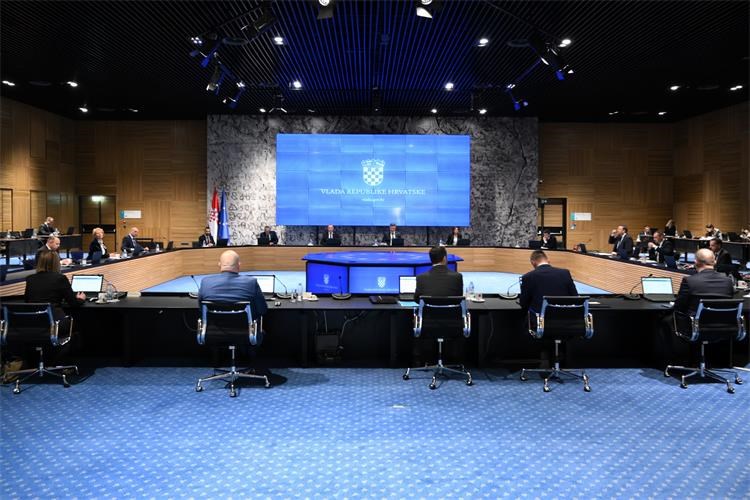
Hina - The government on Wednesday sent to parliament amendments to the law on post-quake reconstruction, which would end Zagreb and Krapina-Zagorje County's entitlement, from next year, to use a share of personal income tax revenue allocated for decentralised functions to fund reconstruction.
"Following the devastating (2020) earthquakes that hit Zagreb and the Banovina region, the government took a series of extraordinary measures to ensure faster and better-quality reconstruction, one of which concerned the financing of decentralised functions," Construction, Physical Planning and State Assets Minister Branko Bačić said.
Under the measure, the City of Zagreb and the counties of Krapina-Zagorje, Zagreb, Sisak-Moslavina and Karlovac were exempted from the obligation to use the 6% share of personal income tax revenue allocated for decentralised functions to cover the costs of those functions, including education, care homes for older people, healthcare and firefighting. Instead, they were allowed to use the funds to deal with earthquake damage and carry out reconstruction.
Under the proposed amendments, the City of Zagreb and Krapina-Zagorje County will return to the regular funding model from 1 January.
For Zagreb, Sisak-Moslavina and Karlovac counties, which declared a state of disaster following the earthquakes, the costs of decentralised functions in their territories will continue to be covered by state budget revenue.
Over the past five years, this arrangement has left local government units with €275.6 million, while the state has allocated €407 million to finance decentralised functions, the minister said.
He added that a further €66 million was expected to be made available to them by the end of the year.
In addition to these funds, the government has so far invested €5.3 billion in reconstruction, of which €3.2 billion went towards the area affected by the Zagreb earthquake and €2.1 billion towards the area hit by the Petrinja earthquake.
"Given the current state of reconstruction, the completion of the Solidarity Fund programme and the National Recovery and Resilience Plan, the costs borne by these local government units have fallen significantly," Bačić said.
News |
Information