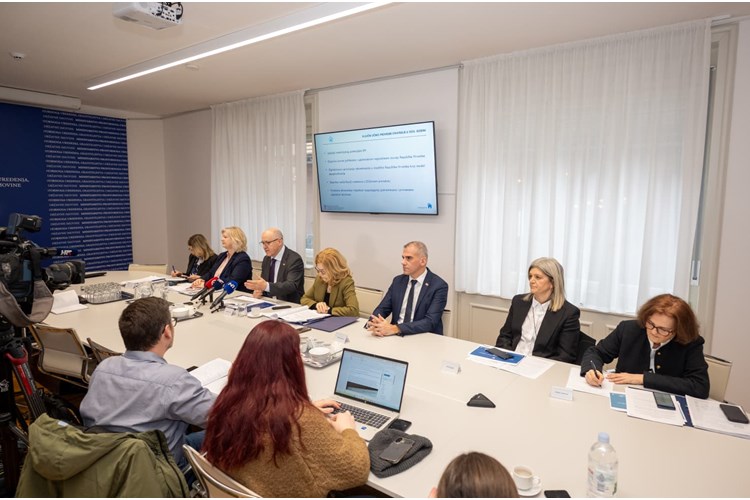
On Thursday Minister of Construction, Physical Planning and State Assets Branko Bačić presented the State Assets Management Strategy until 2035, alongside this year’s Management Plan under which the state aims to generate 75 million euro in revenue.
According to Minister Bačić, the state plans to activate 60% of properties deemed to be of strategic importance by 2035, as well as at least 50% of the activated floor area of non-strategic properties managed by local self-government units.
The state expects to generate 1.2 billion euro over that period from state-owned real estate and movable assets.
This year’s State Assets Management Plan aims to generate a total of 75 million euro, and the Minister also listed real estate of strategic importance under the state’s management in 2026: tourist zone Privlaka, children’s village Promajna, Memorial Home Kumrovec, camp Peruština in Diklo and Villa Svežanj in Kostrena.
This year, Bačić pointed out, Državne nekretnine d.o.o. plans to renovate additional 300 state-owned apartments for affordable rental and housing as well as for protected tenants. Plans also include the renovation of ten commercial premises and two buildings to house state administration bodies and civil society organisations.
"We plan to significantly increase the number of state administration bodies headquartered in premises owned by the state in order to reduce the annual rent payments currently paid by government institutions," the Minister said.
State wants entire Vjesnik and Hrvatska pošta in Branimirova Street
The Minister also said that the state plans to acquire two properties in Zagreb, Vjesnik and Hrvatska pošta in Branimirova Street.
"The first is the purchase of the remaining 36% stake in Vjesnik not currently owned by the state, and the acquisition of the Croatian post building in Branimirova Street. As I said, the properties would be used to accommodate state bodies whose buildings are undergoing renovation or which are currently renting privately owned office space,” Bačić pointed out.
The state plans to issue 177 public tenders for non-strategic properties, including land, apartments and commercial premises, while the relevant authorities expect to conclude 1,900 contracts ranging from sales to building rights and easements.
When it comes to movable state assets and temporarily confiscated property, the plan is to raise 400,000 euro.
Data on state assets
Asked whether the targets were achievable given that the full scope of state-owned assets was still not entirely clear, Bačić said the Ministry managed state-owned construction land as well as commercial and residential units. He said the asset register was currently being digitalised and would soon be publicly available, although a state asset register was already operational under the Ministry's oversight.
"We have very precise data on state-owned assets. The state acquires new property and residential units on a daily basis. I'm confident we will implement this strategy because we have clearly defined the properties,” Bačić stated.
He added that the annual plan clearly listed the properties at the state's disposal and their intended use, particularly when it came to strategic assets. The same applies to non-strategic properties, which he said had been aligned with the needs of county-seat cities and major urban centres that had also taken part in drafting the annual plan.
The Minister also presented amendments to the Act on Construction Products, which will be sent to parliament for a fast-track procedure to align it with EU regulation. The aim is to ensure the effective functioning of the internal market with safe and sustainable construction products. He pointed out that every construction product will have its own digital passport containing all components of that specific product.
Source: HINA/MPGI
News |
Information