- Published: 16.12.2025.
Demographic revitalisation and affordable housing in Government’s focus
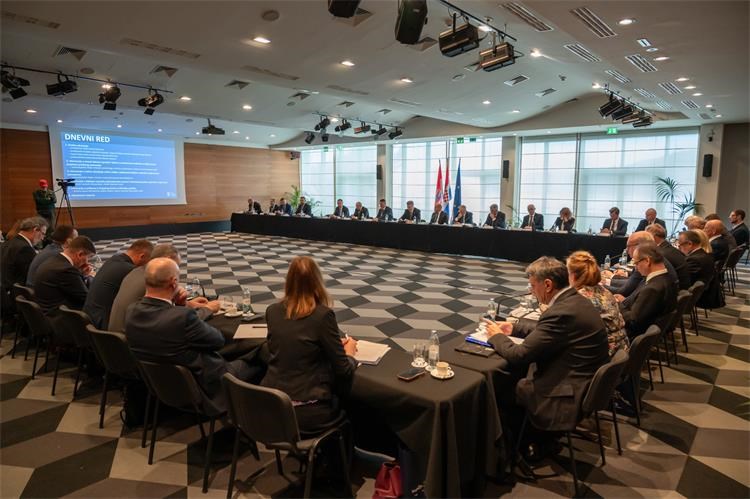
The multilevel management policy achieved results through systematic dialogue, functional and fiscal decentralisation and joint realisation of numerous projects, Prime Minister Andrej Plenković said at the 19th meeting of the Government and county prefects, representatives of the Association of Cities and the Croatian Union of Municipalities in Dubrovnik.
He also announced the new Act on Regional Development, stating that it will formalise such meetings, and he announced the establishment of the Regional Development Committee, Local Development Committee and councils for the Adriatic and central Croatia, based on the successful models established for Slavonia, Baranja, Srijem and northern Croatia.Through functional integration we encourage more efficient management and ensure better quality public services for citizens, the Prime Minister continued, emphasising that by now 253 local and regional self-government units have undergone functional integration.
Minister Bačić on the reform legislative package and affordable housing
Today Deputy Prime Minister and Minister Branko Bačić presented the legislative package to counties, pointing out that this was the third act presentation. “The first presentation was made during development stage and public consultation, the second time during the first reading and today, post festum, following the discussion with counties and associations of cities and municipalities. The representatives were also members of the working group who participated in drafting the act, so it is not surprising that they have supported the acts today,” the Minister said.
The reform legislative package represents comprehensive modernisation of the physical planning and construction systems in the Republic of Croatia. “The goal is to preserve space as a non-renewable national resource, to accelerate and digitise procedures, increase energy efficiency of buildings and create a sustainable and affordable housing framework, namely dedicated to young people and young families,” the Minister clarified.
The adoption of these acts is in line with the National Housing Policy Plan, while the Affordable Housing Act is currently open for public consultation. The new acts establish a single, digitally connected system which simplifies procedures, strengthens legal certainty and enables more efficient spatial planning for affordable housing purposes.
In accordance with the National Housing Policy Plan, the reform package strongly supports affordable housing development as the foundation for demographic renewal. It establishes spatial and procedural prerequisites for the construction of affordable dwellings on different types of land, while the Affordable Housing Programme consolidates local programmes to ensure a coordinated and feasible approach to housing policy.
Minister Bačić put special emphasis on the role of counties in affordable housing implementation. According to the new legal framework, the county can establish a public institution for affordable housing for cities and municipalities which have not established their own institution. In addition, the county develops the local Affordable Housing Programme, adopted by the county assembly.
The county can participate in the construction through financial resources and/or allocation of land, and in that case, it has pre-emption rights when the dwelling is sold. Moreover, the county can donate land to citizens, while the compensation for the purchase of land or establishing the right to build on land from local and regional self-government units and the state cannot exceed 30% of the market price.
100,000 jobs created in two years
Regarding the overall economic situation, the Prime Minister stated that data from the Croatian Employment Service show that today Croatia has 1,751,000 employed and 81,000 unemployed people. Such a high level of employment has never been achieved before, while unemployment is at the level corresponding to natural unemployment rate, Plenković highlighted.
The number of newly employed people over the past two years is 100,000, the Prime Minister continued, pointing out that this means that 100,000 new jobs have been created in the last two years. The average salary is 1,456 euro, the median salary is 1,260 euro and the minimum gross salary as of January 1 is 1,050. He also pointed to the Government's intention for the average salary to reach 1,600 euro by the end of the term, in mid-2028.
The Prime Minister also recalled that the first annual pension supplement will be paid on Friday, and that the average overall pension will reach 700 euro in late 2025, which is almost twice as much as in 2016.
Croatian economy has experienced 19 consecutive quarters of growth
He also talked about inflation, warning that we must combat inflationary pressures together. However, the growth of real salaries and pensions is higher than the inflation was, he pointed out.
The Croatian economy has experienced 19 consecutive quarters of growth, the absolute GDP has risen by nearly 100%, from 47 billion euro in 2016 to 93 billion euro at the end of this year. GDP per citizen will reach 78% of the European Union average this year, and it was 62% at the start of the term, Plenković said, adding that the goal is to exceed 80% of the European average by the end of the term.
He also recalled that credit rating agencies maintain Croatia at an A investment-grade level with positive and stable outlooks. We have overcome crises together, there were no waves of layoffs or bankruptcies, nor were the existential, economic or social conditions of our citizens ever threatened, Plenković said.
Citizens to receive 350 million euro of interest rates through investment in government securities
The Government has dynamized the capital market by issuing 18 government securities - 15 treasury bills and three bonds open to citizens. This demonstrates confidence in the the economic policy direction we pursue, the Prime Minister emphasised, stating that by now nearly 350 million euro of interest rates has been paid to citizens from investment in government securities.
He also commented on the Government’s reform that abolishes surtax and enables cities and municipalities to independently determine income tax rates. He pointed out that in the first 11 months of 2025 income tax revenues of all counties, cities and municipalities increased by 15% in comparison to last year - 17% for counties, 18% for municipalities and 12% for the City of Zagreb.
Croatia submitted a request for the 8th payment of nearly 900 million euro from the Recovery and Resilience Facility
Regarding other topics, the Prime Minister mentioned the successful implementation of the National Recovery and Resilience Plan, saying that Croatia is yet to fulfil certain criteria and indicators for the 9th and 10th instalment from the Recovery and Resilience Facility, amounting to 2.8 billion euro.
He highlighted that yesterday the Government submitted a request to the European Commission for the payment of the 8th instalment from the Recovery and Resilience Facility, based on the fulfilment of all 17 indicators set by the National Recovery and Resilience Plan, amounting to nearly 900 million euro.
He added that by the end of the month we expect the payment of the 7th instalment amounting to 1.07 billion euro, pointing out that Croatia is the only country to have completely met all obligations in the first eight requests.
He also said the deadline to send the 9th and 10th instalments is this summer, which means that our country, as he said, will fully conform and absorb all available funds from the “Next Generation EU Instrument”, which significantly contributed to the development of all parts of Croatia.
The Prime Minister also stated that our country currently has a surplus of 18 billion euro with regard to contribution to and disbursement from the European budget, noting that the first preliminary discussion on the Multiannual Financial Framework at the level of heads of state and government will be held on Thursday in Brussels.
European Funds will not run out
In this context, he commented on, as he said, false and bizarre thesis emerging in public about European Funds running out. He pointed out that this is not true and that in July this year the European Commission proposed the largest seven-year budget ever.
“Among the proposed two trillion euro, there will certainly be money for Croatia as well,” Plenković stated ironically. He clarified that there will be no “Next Generation EU Instrument” because there is no need for it given that there is no pandemic of that magnitude.
To illustrate Croatia’s developmental progress, the Prime Minister said that nine years ago we contributed 500-600 million euro to the European budget per year, while our membership contribution today amounts to 900 million euro per year. He added that in the next financial perspective, the country will contribute around 1.5 billion euro per year to the European Union budget.
Demographic revitalisation essential for the survival of the Croatian people
Referring to topics from today’s meeting, the Prime Minister highlighted demographic revitalisation as one of the most important topics, stressing that it represents an essential issue regarding the survival of the Croatian people. He believes the Government has made good progress in reducing negative demographic trends and that, as he said, it will continue to foster a positive social environment to reverse the trends.
Although it is not a topic of today’s meeting, he also mentioned the healthcare system reform, followed by large investments in hospitals, health centres and mental health. We expand, he said, preventive programmes and reduce waiting lists.
In the context of safe and affordable energy, the Prime Minister mentioned increasing the capacity of the LNG terminal on Krk to 6.1 billion cubic metres of natural gas per year, emphasising that, by increasing the terminal’s capacity, Croatia further strengthens its position as a regional energy hub.
Today’s agenda also includes topics from the field of physical planning and housing. The Prime Minister considers today’s meeting an opportunity to provide the public with a truthful explanation of the purpose and objectives of the new acts on construction and physical planning, which he describes as important for the realisation of the affordable housing policy that will also contribute to addressing housing issues for young families.
Opposition uses its frustration to create a sense of chaos
In a statement to the media following the meeting, Prime Minister Andrej Plenković addressed other current issues, namely the announcement by some opposition parties that they plan to submit the three acts in the field of construction to constitutional review and to potentially initiate a referendum.
Stating that the left-wing opposition has clearly chosen the strategy of creating a false sense of chaos, he added that this is clearly not true and that it only exists in certain internet-media spheres.
This bubble they created, the Prime Minister said, clearly stems from the feeling of frustration among left-wing political parties because they have been in opposition for ten years, adding that he politically understands their frustration.
He pointed out that said acts are adopted in favorem of citizens and that they enable the implementation of the affordable housing policy for young people and have their own housing and demographic dimensions.
He still does not see, he pointed out, what could be considered unconstitutional in those acts.
When asked about criticism from part of the professional community, the Prime Minister explained that consultations were held with a much broader number of experts during the drafting of the acts, and that this other part of the professional community is strongly in favour of these acts.
If the opposition believes that something is not in line with the Constitution, they should submit a request to initiate constitutional review before the Constitutional Court, and then we will see, he added.
Source: vlada.gov.hr/MPGI