- Published: 17.02.2026.
Government adopts Affordable Housing Act
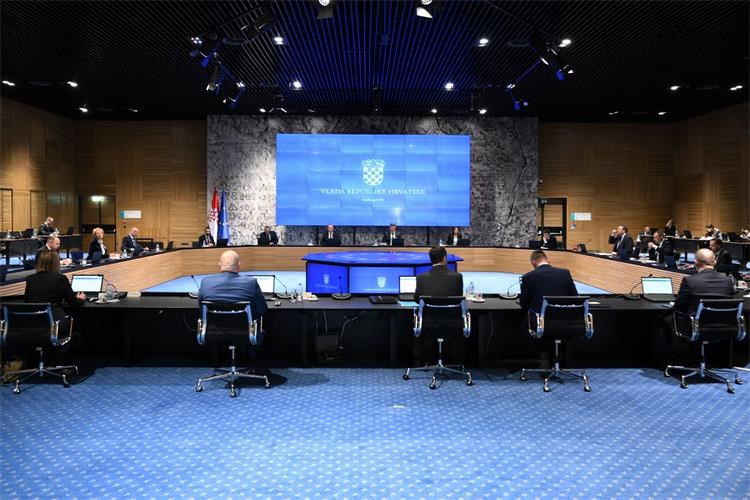
At today’s session, the Government adopted the proposal of the Affordable Housing Act, which will be submitted to parliamentary procedure. The adoption of this act is envisaged by the National Housing Policy Plan of the Republic of Croatia until 2030, with the aim of ensuring affordable housing.
The Affordable Housing Act is an umbrella legislative framework developed based on the National Housing Policy Plan of the Republic of Croatia.“The National Plan, adopted by the Government in late March last year, determined necessary interventions regarding legislation of the Republic of Croatia. We envisaged eight acts - in the meantime we have adopted the Act on Building Management and Maintenance, the Act on Amendments to the Act on State-Subsidised Housing Construction, we have amended the Act on Housing Care in Assisted Areas, and in December we adopted the Physical Planning Act, the Building Act and the Act on Energy Efficiency in Building Construction,” Minister Bačić said, adding that he believes the Affordable Rental Act will be adopted by summer as well.
Measures stemming from the housing policy entail increasing the housing supply, regulating the rental market and reducing regional differences. The Act prescribes the buildings must be designed according to the principles of rationality, modular construction and green infrastructure.
“We prescribe the obligation to build rental apartments - in multiapartment buildings, 50% of housing units will be for sale and 50% for rental. If a multiapartment building has less than 10 housing units, all of them should be intended for rental,” the Minister explained.
It is also forbidden to alienate the apartments during loan repayment - the deadline to repay the loan has been extended to 35 years, during which time it is not possible to sell the apartment, except in cases determined by law. APN and local self-government units have the right of first refusal, and it is possible to purchase an apartment through instalments under affordable conditions in terms of price, interest rates and repayment term.
For the first time, the concept of a micro housing unit is introduced into housing construction. It refers to smaller-sized units intended for transitionary periods of individuals resolving their housing situations.
In addition, the role of self-government units increases, and for the first time, the field of housing includes counties as well, which will be able to participate in providing housing care. Local and regional self-government units participate in the implementation of the Act by establishing public institutions, developing local housing programmes, providing land, co-financing construction and amending spatial plans. They monitor citizens’ needs, collaborate with APN and may exempt projects from paying utility charges and facilitate their implementation otherwise.
The Act envisages the development of the national Affordable Rental Programme, developed by APN, while local and regional self-government units will develop their own programmes. This ensures affordable housing through the construction of such buildings in urban, peri-urban and rural settlements, it defines locations, citizens’ needs, implementation measures, available resources and plans to build apartments to rent or purchase.
Bodies to implement the Act
The Act shall be implemented by the Government of the Republic of Croatia through the Ministry, APN and local self-government units. APN is the central investment body.
The Act will be implemented through the construction and reconstruction of buildings and family houses, while putting strong emphasis precisely on family houses.
“So far, they played second when it comes to housing care. Here we have more favourable conditions for peri-urban and rural settlements in Croatia, and we also introduce substantial incentives and subsidies for the reconstruction of multiapartment buildings and family houses,” the Minister pointed out.
Other implementation models entail subsidies for the acquisition of first residential real estate and affordable rental programmes, building reconstructions, construction of family houses in urban, peri-urban and rural settlements. The subsidies are allocated for the purpose of improving residential conditions, increasing energy efficiency, enhancing housing quality and ensuring adequate living space.
“By now, 4.328 tax return applications have been received for the acquisition of first residential real estate. The call for owners of vacant apartments for the Affordable Rental Programme ended on Sunday, and applications arrived from across Croatia,” Minister Bačić said.
Activating vacant residential real estate represents a separate mechanism to include the existing and unused housing stock into the affordable housing system, with the aim of expanding access to rental apartments without the need for new construction. The mechanism is conducted by APN, with financial support from the Republic of Croatia and with possible involvement at the local level.
Available residential real estate may be acquired from their owners, so APN could offer them at affordable rents, provided that the real estate has not been used for at least two years prior to the date of publication of the public call, i.e. that they are fit for use or require only minor works. APN and local public institutions manage the apartments, commercial spaces and common areas of the buildings. Financial surpluses must be used solely for further construction and maintenance of the stock, which ensures the system’s self-sustainability.
The concept of non-profit housing cooperatives is also introduced into Croatian legislation - members will have a common share in each apartment, which will enable a more affordable construction of buildings, while the non-profit housing cooperative will be the investor.
Affordable purchase and rental prices, 20,200 new housing units by 2030
The affordable Housing Act regulates systematically organised housing construction, acquisition and procurement of residential real estate financed or co-financed through public resources, as well as the housing stock management.
Target groups entitled to subsidies or housing care are citizens with lower income, people under the age of 45, families with children, people in shortage occupations, people involved in precarious work, active military personnel, police officers, state and public officials and employees in shortage occupations, people over the age of 65, citizens with limited access to healthcare and others who need housing support. The prerequisite is that they do not own adequate residential real estate.
For the first time, the Act introduces the concept of affordable housing into Croatian legislation - it refers to housing where rental prices or credit instalments for an apartment of the corresponding net usable surface area increased by the average utility and maintenance costs does not exceed 30% of the immediate family’s income. The concept of non-profit housing cooperatives is also defined - in accordance with the cooperative’s principles, they are responsible for the construction, reconstruction, management and maintenance of the buildings to the benefit of their members.
The income criterion has also been established, the Minister explained, which means that “affordable housing programmes are open for citizens with maximum income of two and a half median net salaries, while the amount is increased by 0.5% of the local median net salary for each family member.”
The Act envisages the purchase and rental of apartments under affordable prices, calculated according to actual construction costs and developmental indexes of local self-government units. In the case of renting an apartment, affordable rent is determined according to the total income of the immediate family, utility costs and real estate maintenance costs. Buyers and renters are selected through public calls and priority lists.
“The apartment price does not entail the building land, municipal and other infrastructure and utility charges, which will contribute to lower apartment prices. The price will not be the same in all units, as it is also defined according to regional developmental indexes,” the Minister added.
According to the new Affordable Housing Act, the Minister pointed out, over the next four years the state plans to build and reconstruct 20,200 apartments and family houses, whereby 8,000 of them refer to new apartments built by the Agency for Transactions and Mediation in Immovable Properties (APN), and 9,000 apartments refer to vacant apartments activated for the purpose of affordable housing.
The construction resources are secured by the Republic of Croatia, local and regional self-government units, APN and financial institutions. The plan is to use funds from the state budget, as well as from different financing models of the European Union and loans in the future.
“By 2030 we plan to secure 2 billion euro, and through MFF 2028-2034, another 3.5 billion euro in order to achieve affordable housing,” Minister Bačić concluded.