- Published: 25.11.2025.
Members of Croatian Parliament discuss amendments to Act on Housing Care in Assisted Areas
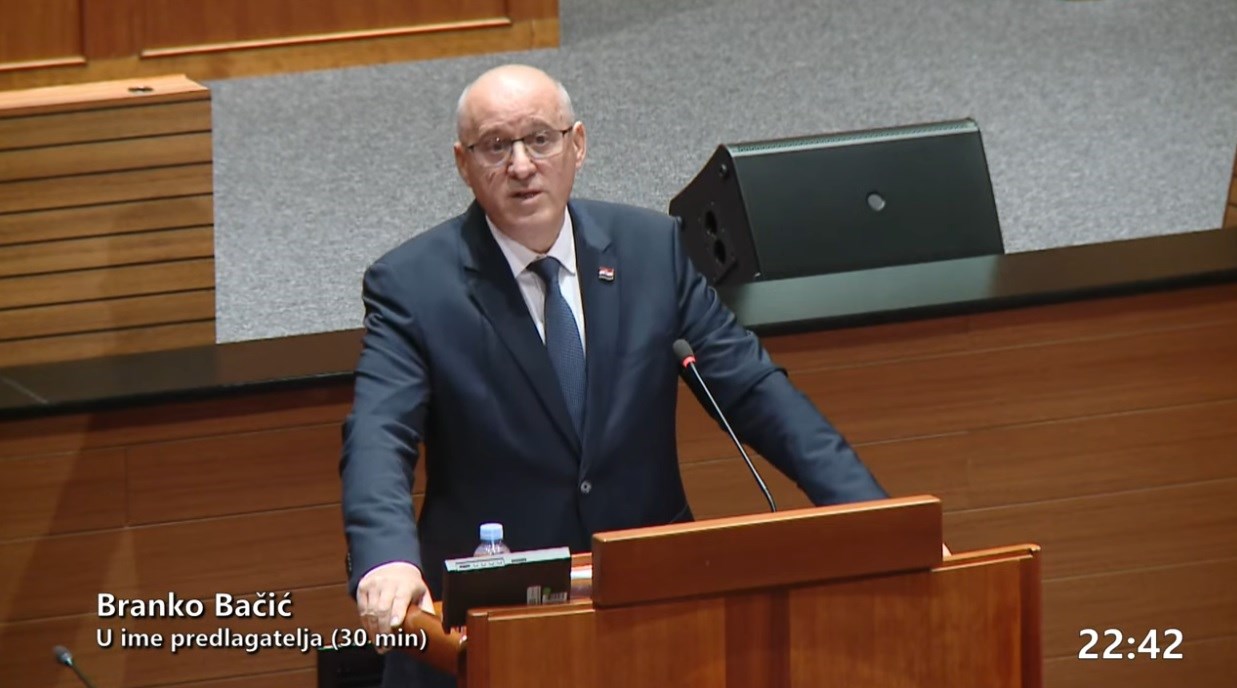
Today the Croatian Parliament discusses the final proposal of the Act on Amendments to the Act on Housing Care in Assisted Areas, which is a major step forward in further improving the system and legal framework of housing care in assisted areas.
The Act is presented by Deputy Prime Minister and Minister of Physical Planning, Construction and State Assets Branko Bačić, and the parliamentary discussion is also attended by State Secretary Dario Tišov.“The current Act, adopted in 2018, ensures permanent, appropriate and affordable housing to our fellow citizens living or wishing to return to assisted areas, war-affected areas or demographically challenged areas in order to encourage renewal, return, stay and demographic revitalisation in these areas. Over the past six years, the Act has changed two times. This amendment is aimed to enable easier access to housing care for our fellow citizens living in assisted areas, namely by introducing new models of housing care,” Minister Branko Bačić said.
The new models include the possibility to purchase a state-owned apartment unfit for habitation, as well as the donation of construction materials to rehabilitate apartments located on the top floor or in the attic of subdivided family houses. Moreover, the amounts for construction material donations have been increased from 25% to 50% due to rising prices of construction products and services.
This Act Proposal establishes a uniform rent amount for all housing care beneficiaries under its scope, which is set at the rate of protected rent - 0.36 euro per square meter.
“We have unified the rent paid by tenants in state apartments and state houses. The maximum amount is determined as 36 euro cents per square metre, which is equal to protected rent paid by all protected tenants in the Republic of Croatia. So far there were different rent amounts depending on the local self-government unit’s development index, but now they are all equal,” the Minister clarified.
The Act specifies the procedure in the event of terminating the rental agreement, especially when the beneficiary acquires another housing unit fit for habitation during the rental agreement, as well as in the event of terminating the agreement on the donation of construction materials, for instance if the beneficiary refuses to sign the contract or opts out of the renovation.
It also introduces a mandatory residency period as the prerequisite for acquiring the rights for purchase or donation.
“The minimum residency period in housing units owned by the Republic of Croatia to acquire the rights for purchase or donation is five years. If the housing unit was built through interdepartmental cooperation or if the construction of the housing unit was cofinanced by European funds, the minimal timeframe after which it is possible to apply for donation or purchase is 10 years,” the Minister added.
Moreover, a three-year transition period is introduced for local self-government units which have lost the assisted area status. During this period, they will be able to generate income from selling real estate on their territory.
The Act further regulates housing care for Croatian emigrants, descendants of emigrants and members of their families who return to the Republic of Croatia, in cooperation with the Ministry of Demography. It also prescribes the procedure for providing assistance with housing care of Croatian citizens in Bosnia and Herzegovina. It also resolves the matter of citizens who had tenancy rights but were unable to exercise them.
Furthermore, it defines the possibility of providing care to victims of domestic violence before the adoption of a final judgement.
“Since legal proceedings in these cases can also take a long time, the victim of domestic violence must secure housing on their own. With this proposal, we have prescribed that it is also possible to issue a housing decision based on a non-final judgement, and we have not taken into account the income threshold of the domestic violence victim,” the Minister pointed out.
Following the first discussion in the Croatian Parliament, certain remarks and suggestions have been accepted.
“We have accepted that a prohibition of disposal can be lifted even before the five-year period expires provided that there are extraordinary circumstances, such as changed living conditions or serious health issues. Furthermore, we have determined a deadline for local self-government units to respond to tenants who apply for real estate purchase. Another novelty is that so far interdepartmental cooperation was carried out solely with local self-government units, while now this is also a possibility for regional self-government units,” the Minister concluded.
The Amendments to the Act introduce specific improvements in the housing care system in assisted areas, which contributes to better availability of housing to the most vulnerable groups and to long-term preservation of demographic stability of these areas.
-
Final Proposal of the Act on Amendments to the Act on Housing Care in Assisted Areas (second reading)