- Published: 10.12.2025.
Members of Croatian Parliament discuss three sectoral acts – on construction, physical planning and energy efficiency in building construction
A package of three bills on construction, physical planning and energy efficiency in building construction receive a second parliamentary reading, votes in favour of separate discussions for each act instead of a joint discussion.
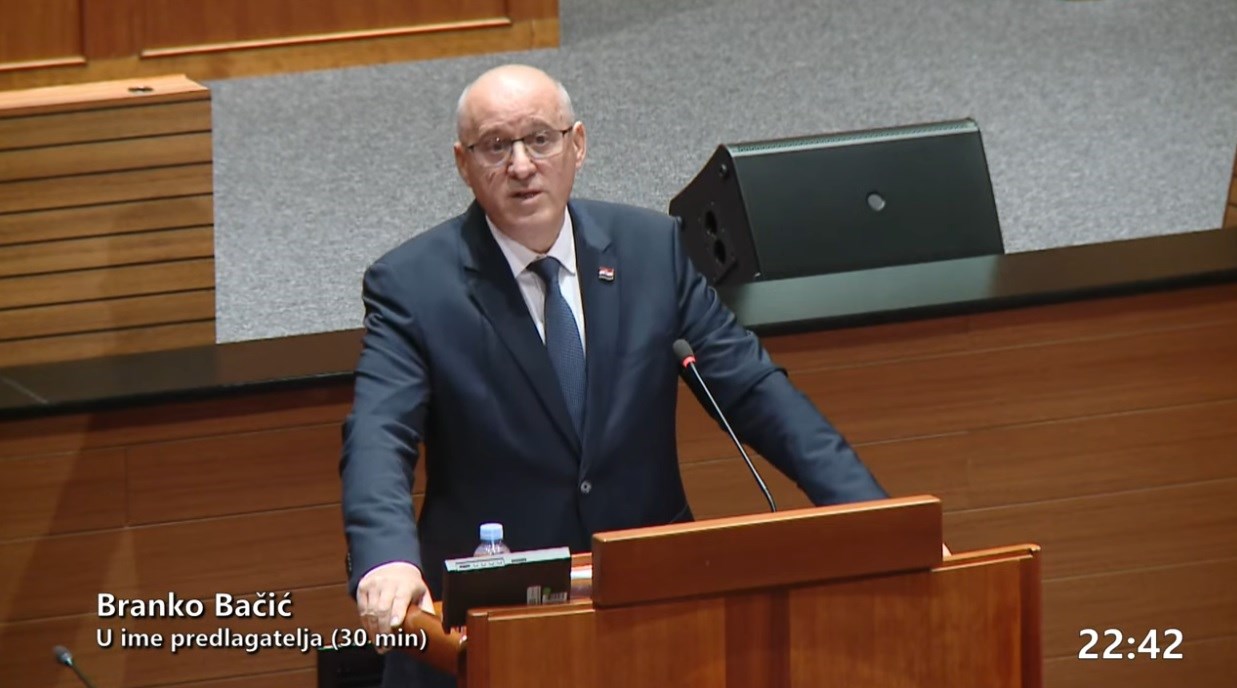
Building ActDeputy Prime Minister and Minister Branko Bačić presented the act and pointed out that the changes to the act proposal, in comparison to the first reading, are minimal and namely nomotechnic, and have been defined and determined between readings.
“The main starting point of the new Building Act is creating a contemporary, simplified and transparent legislative framework for construction. It will accelerate the issuance of permits, increase construction safety, strengthen the responsibility of all stakeholders - designers, investors, contractors, supervisors and administrative bodies - and enhance digitisation of the construction sector. We have extracted provisions on energy efficiency in building sector from the current act and covered them in a separate act in line with the new European directives. The main novelty is the completed e-permit system carried out through the Physical Planning Information System that enables designers to obtain all necessary procedures and special requirements, including connection requirements, independently and electronically without the traditional running from office to office, which simplifies and accelerates procedures, especially for less complex and multiapartment buildings, with less documentation, shorter deadlines and lower costs for citizens,” Minister Bačić pointed out. He clarified that approximately 90% of all building permits in Croatia is issued precisely for family houses.
“For such and other less complex buildings, the building permit is issued based on the conceptual design, which significantly accelerates the procedure, and the general administrative procedure envisages a 60-day deadline to issue a decision, but it is realistic for the administrative body to decide in around 30 days, which reduces the burden on administrative bodies and increases the responsibility of designers. The act introduces the obligation to develop a detailed design for all construction works, except the less complex ones, which is aimed to raise the quality of construction and reduce technical risks.” Minister Bačić presented the detailed design as the key measure for the safety of built objects.
“At the same time, less documentation is required for less complex residential houses up to 400 m2 and agricultural objects up to 600 m2; the main project is no longer required to obtain the permit, but the investor is obliged to have the main project only when registering the start of construction. Deadlines are extended without the need for an additional administrative procedure because the permits issued by the city or county are valid for six years, and those issued by the Ministry are valid for eight years, which also reduces administrative burden and increases legal certainty of investors, because they operate within a longer, more stable framework to realise the projects” Bačić highlighted.
The act also thoroughly prescribes obligations and responsibilities of all stakeholders in construction - designers, supervisors, contractors, investors and public law bodies. It also states consequences for not adhering to legal and prescribed obligations, and it especially highlights the introduction of responsibility for public law bodies in the event of failure to act or delays in order to ensure higher system efficiency. In this way, it raises the level of professionalism, responsibility and safety in the sector. This legal solution also introduces BIM model as the standard in the construction system. It is a joint digital 3D model that connects designers, investors and contractors, enables integrated planning and designing, coordinated construction and object management and maintenance through the smart 3D model. It further encourages digitisation, transparency and cooperation of all parties in the construction process.
Physical Planning Act
Minister Bačić stated that the new Physical Planning Act “elevates” space protection, that no lobby or interest groups have affected its development and he rejected the opposition’s claims of privatisation 2.0.
In comparison to the current act, the new one elevates space protection by “four, five steps,” Minister Bačić pointed out at the parliamentary discussion on the new act.
He rejected claims that the act is drafted “to suit a particular professional guild, lobby group or vested interest.” “The Physical Planning Act is drafted to establish balance between space preservation and economic development,” the Minister pointed out.
He highlighted that this reform package constitutes a single, digitally connected and aligned system that preserves space, which is, together with people, the most valuable national asset. “This is a systematic reform that interconnects space, construction and energy - three foundations of sustainable development, competitive economy and better lives of the citizens of the Republic of Croatia. In addition, this legislative package digitises all construction and physical planning processes, simplifies procedures, encourages affordable housing and, through measures of energy efficiency, builds a resilient and self-sufficient Croatia,” the Minister said.
Minister Bačić clarified that the basic intention of the new Physical Planning Act and the Building Act is faster construction of dwellings for affordable housing.
There is no affordable housing without changes to acts, we want simpler procedure
“If we don’t make changes to the acts on physical planning and construction, if we don’t enable instruments of accelerated changes to spatial plans and accelerated issuance of building permits, we won’t be able to achieve that goal, while still claiming that affordable housing is not available to us. These were the reasons why we accepted this model of changing spatial plans through a simpler procedure in order to build affordable housing units,” Minister Bačić said.
He also commented on the criticism that it is possible to build on land which is not currently designated as building land. As he explained, for the purpose of quick realisation of new housing units for affordable housing, it is possible, through an urban development project, to start construction on such land which is equipped with necessary infrastructure in terms of utilities, transport and energy. He pointed out that it surely does not mean the act provides for building land expansion.
“It is not possible to expand building land anywhere in Croatia if the existing building land is not equipped with municipal infrastructure. This is my response to everyone saying that we contribute to space devastation and building land expansion, to new overbuilding and new apartmentification of Croatia. Considering the importance of affordable housing, now it is possible to go beyond building land only for the purpose of affordable housing and only if the investor is a public investor,” Bačić stated.
The Minister also clarified why the act allows faster realisation of construction plans by other investors, which also sparked intense controversy. As he said, if spatial plans designate building land, then this person, the owner of the land, has legitimate expectations to be able to build there. In order to build, he continued, he has to wait for the urban development plan as well.
If LSGU designated land as building land, it also has to equip it
In comparison to the first reading, the deadline for local self-government units to adopt an urban building plan, following an investor’s prior letter of intent requesting permission to build, has been increased from two to three years. If local self-government units do not adopt the urban plan within the specified deadline, the act allows the investor to “contact the ministry, which then carries out a traffic study, defines the route of the future roadway so the road can be built and the investor can obtain a building permit,” Minister Bačić said.
This is, he says, the least the Government responsible for implementing acts in the Republic of Croatia can do in order to allow our fellow citizens to truly have their building land designated as such and obtain building permits for family houses, business centres, multiapartment buildings. “This caused controversy because of claims that the Government takes over the jurisdiction of local self-government units. And my response is that under the Constitution and the law the local self-government unit is competent and entitled to develop space under its jurisdiction, but it is also obliged - which is what we insist on - to develop the land designated as building land by that unit,” Minister Bačić stated.
The new legal solution enables the investors who own the land to do it on their own, if they have the financial capacity, but then utility charges paid to the local self-government unit should be reduced by that amount.
Minister Bačić also reminded the public on the current provision. If a city has not adopted a lower-level plan for the land the same city has designated as building land, then the land automatically ceases to be considered building land after seven years.
Minister Bačić also said that all amendments between the readings were suggested by the Chamber of Architects.
Energy efficiency and self-sufficiency of Croatia
The Act on Energy Efficiency in Building Construction is key for accomplishing energy independence and economy resilience.
It transposes the revised Energy Performance of Buildings Directive (EPBD) into the Croatian legal system, and the act establishes the prerequisites for:
- reducing energy costs for citizens and the public sector,
- reducing energy poverty by encouraging reconstruction and investment in sustainable buildings,
- developing the National Building Renovation Plan and increasing investment in renewable energy,
- green job creation in the sector of construction and energy.
The act is an important step forward towards the goal that Croatia becomes an energy self-sufficient state which uses its resources rationally and builds a sustainable future.
Reform breakthrough for a sustainable and digital CroatiaThe three acts form a single, digitally connected and reform-aligned system which:
- preserves space as the most valuable national asset,
- digitises all physical planning and construction processes,
- simplifies procedures and encourages affordable housing,
- builds a resilient and self-sufficient Croatia through energy efficiency.
“These three acts establish a single and digitally connected system which preserves space as the most valuable national asset, simplifies procedures and encourages construction, namely of affordable housing. It is a reform breakthrough which intertwines space, construction and energy - the three pillars of sustainable development and better lives of citizens,” Minister Bačić concluded.