- Published: 17.11.2025.
Sixth session of Expert Council for Reconstruction held in Petrinja


Today the sixth session of the Expert Council for Reconstruction was held in the premises of Gradska Munjara in Petrinja. Deputy Prime Minister and Minister of Physical Planning, Construction and State Assets Branko Bačić presented the Mid-year report on the effects of post-earthquake reconstruction implementation for the period from January 1 to June 30, 2025, and a discussion followed on the current progress of the works and plans for the upcoming period.
Minister Bačić pointed out that reconstruction is advancing well and will continue at the same pace. Even though the Government has chosen a strategic concept of modern structural reconstruction which is more complex and financially more demanding, in the end it is safer and of higher quality.“According to our plan, 2030 should mark the completion of the entire reconstruction process in the Zagreb and Petrinja earthquake areas,” the Minister said.
For the first time, the session of the Expert Council for Reconstruction was held outside Zagreb, in Petrinja. Mayor Magdalena Komes expressed her gratitude that Petrinja was able to host the event. She recalled that Petrinja is the only city which assumed the reconstruction of a protected cultural unit in cooperation with the Ministry of Culture and Media - the reconstruction of the very historical centre.
“We are pleased with the pace, but there is still a lot of work ahead of us in order to complete the reconstruction of family houses and enable all dwellers of Petrinja and other residents of Sisak-Moslavina County to come back to their homes,” she stated and expressed her gratitude that the session of the Expert Council was held precisely in Petrinja.
By the end of June this year, works on 13,556 objects were completed - 12,820 objects refer to private property and 736 to projects from the EU Solidarity Fund. A total of 410 houses and 26 multiapartment buildings was built, and 157 state apartments were reconstructed and renovated.
The Minister also commented on the post-earthquake reconstruction status today:
“By today, 14,089 reconstruction projects have been completed - 13,302 referring to private buildings with 53,120 separate units and 787 to projects from the Solidarity Fund. A total of 467 family houses has been built, together with 43 multiapartment buildings, out of the 59 planned. The reconstruction is in progress at 2,004 locations, and 1,710 objects are in the public procurement process - 370 multiapartment buildings and 1,340 family houses, with a total worth of 133.9 million euro,” Minister Bačić said.
“We are building 234 family houses and 17 multiapartment buildings,” he added.
He pointed out that 130 energy efficient mobile homes were built, which temporarily house citizens who await reconstruction or resolution of their statuses. Three settlements of wooden houses were built in Sisak, Petrinja and Glina, which now serve the purpose of accommodating citizens, and after the reconstruction, they will serve as additional capacities for accommodating senior citizens.
By now, 4.12 billion euro has been invested in reconstruction - 2.39 billion euro referring to the area affected by Zagreb’s earthquake and 1.73 billion euro to the area affected by Petrinja’s earthquake.
Professor Josip Atalić, PhD, from the Faculty of Civil Engineering, University of Zagreb, highlighted the importance of establishing a system for the future and the necessity of digitalising implemented projects, so they serve as the basis for future reconstructions. Nina Dražin Lovrec - President of the Croatian Chamber of Civil Engineers - agreed and emphasised the importance of passing acquired knowledge, since the results achieved in post-earthquake reconstruction are admirable not only in terms of numbers, but in terms of the knowledge acquired.
Special advisor to Minister Bačić Dominik Skokandić presented projects of block reconstruction. In 2024 the Ministry started to develop the concept which enables reconstruction of 200-250 housing units within a street or a settlement under one public procurement process, which yields substantial savings and accelerates the projects. This model was used to reconstruct the Mali Vatikan block, comprising 239 apartments and 20 business units. Block 20 in Zagreb is under preparation, as well as the reconstruction of blocks Kukovićeva kuća, Zrinski, Visoka, Jelačić and Medulić. Block reconstruction is also being implemented in Sisak, Petrinja and Glina - the total value of the projects is 33 million euro, and they include 34 entrances and 369 units. The total value of block reconstructions being prepared, announced or implemented is 94.8 million euro, comprising 126 buildings and 1,375 units.
State Secretary Tonči Glavinić presented projects financed by the World Bank loan. Let us recall, in July 2020 the Republic of Croatia concluded a Loan Agreement with the World Bank for 183.9 million euro, and the total value of the projects is 244.2 million euro.
“Six projects are implemented under the loan, two of which have been completed - Reconstruction and Upgrading of Paediatric Oncology and Haematology at KBC Zagreb and the new Vocational Secondary School in Petrinja,” the State Secretary pointed out.
Furthermore, a contract on constructing a new student dormitory in Petrinja was concluded, procurement was carried out and a contract concluded on project documentation development services for the construction of building “A” of the Faculty of Electrical Engineering and Computing in Zagreb, comprehensive reconstruction works are in progress on the Croatian Institute for Public Health building at Nazorova 53, and the largest project is the third stage of reconstruction and construction of KBC Zagreb.
“Two new buildings - a hospital and a parking lot - and the project is worth 206 million euro, out of which 50 million euro has been secured additionally by the Government’s decision. The project is developed in BIM model, the pace is satisfactory, and we believe the parking lot will be completed even before the deadline. The completion deadline is July 2027,” State Secretary Glavinić added.
Director of Directorate for Energy Efficiency in the Buildings Sector, European Union Projects and Programmes at the Ministry Irena Križ Šelendić presented the implementation of the comprehensive reconstruction of public use buildings. She pointed out that Croatia is among the first European countries to choose the “Build Back Better” concept, and the reconstruction entails numerous large complexes - hospitals, faculties, museums and schools. A total of 86 comprehensive reconstruction projects has been completed, 116 are in progress, and an interdepartmental working group has been established to monitor construction sites and ensure the projects are implemented in due time - by the end of June 2026. She highlighted some examples of completed projects - the Gornji Grad Secondary School, Dr. Ivan Merz Primary School, Petrinja Secondary School and Dr. Ivo Pedišić General Hospital in Sisak.
Reconstruction in Sisak-Moslavina County and the City of Zagreb
County Prefect Ivan Celjak presented the reconstruction of public use objects in Sisak-Moslavina County. He pointed out that, unlike Zagreb’s earthquake, public use buildings were completely unfit, and the users had to move out. A total of 15 hospital buildings, 11 health centre buildings, 24 schools, as well as objects from the field of social care, culture and public use, has been constructed, reconstructed and equipped, along with the development and modernisation of road infrastructure and projects of economy and entrepreneurship.
“The county now has almost completely new education, healthcare and social care systems, and the reconstruction already yields results - 80 babies more than in the same period last year were born in the hospital, and after the reconstruction of the school building in Petrinja, 50% more first-graders enrolled in primary schools. When we also add the large developmental project of constructing the highway and increasing the housing stock, Sisak-Moslavina County is already becoming a more desirable place to live,” the County Prefect said.
As part of the post-earthquake reconstruction and revitalisation of Sisak-Moslavina County, 43 multiapartment buildings have been built out of the planned 59, whose construction will increase the housing stock by a total of 1,024 new housing units.
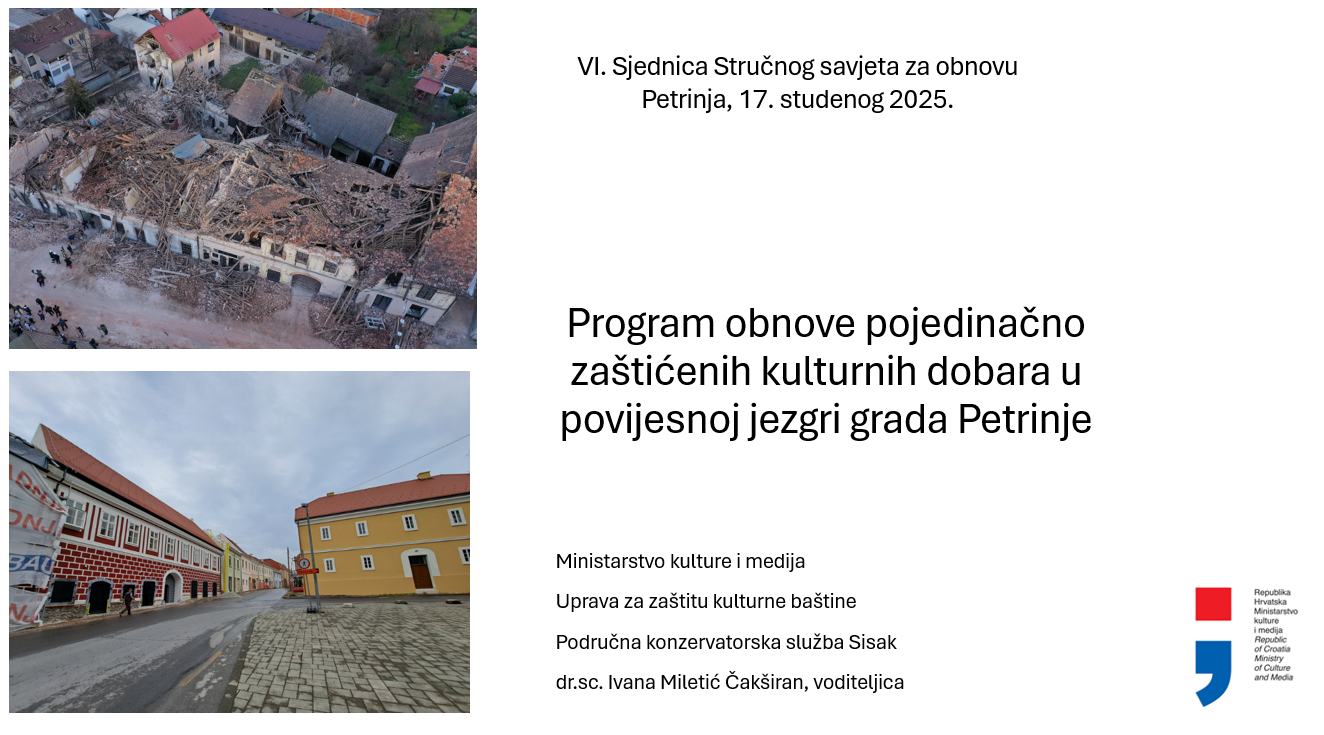
Ivana Miletić Čakširan, PhD, Head of Regional Conservation Department in Sisak, presented the reconstruction of the cultural-historic unit of the city of Petrinja. The Ministry of Culture and Media has adopted the decision on a centralised approach to reconstructing the centre of Petrinja, and it entails 26 construction works. Two reconstruction projects are in progress, whose completion is expected by mid-next year, if not sooner. Out of the 26 buildings, 24 will ultimately be completed.
Deputy Mayor of the City of Zagreb Luka Korlaet presented the reconstruction status of public buildings and infrastructure of the City of Zagreb. Out of 207 projects, 194 have been completed - 12 comprehensive reconstruction projects, while 13 reconstruction projects are in progress. They mostly refer to projects from the education system.
“When I compare the situation to the first session, a great deal has been done, and the overall atmosphere has changed substantially. Who knows when reconstruction would have begun and whether we would have ever drawn this much funding if the earthquake hadn’t happened - every cloud has a silver lining,” Korlaet said.
.png)
Fifth anniversary of Petrinja’s earthquake in December
Minister Bačić announced the anniversary of Petrinja’s earthquake on December 28 and 29, when the reconstructed buildings in Sisak-Moslavina and Karlovac Counties will be open to public. He also announced developing a new legislative framework for reconstruction, since the current one refers solely to Zagreb and Petrinja’s earthquakes and does not apply to future crisis situations. The new legislation would define clear procedures for the Government, the ministries and local self-government in the event of new earthquakes or natural disasters.