- Published: 15.12.2025.
Three sectoral acts adopted in Parliament – on construction, physical planning and energy efficiency in building construction
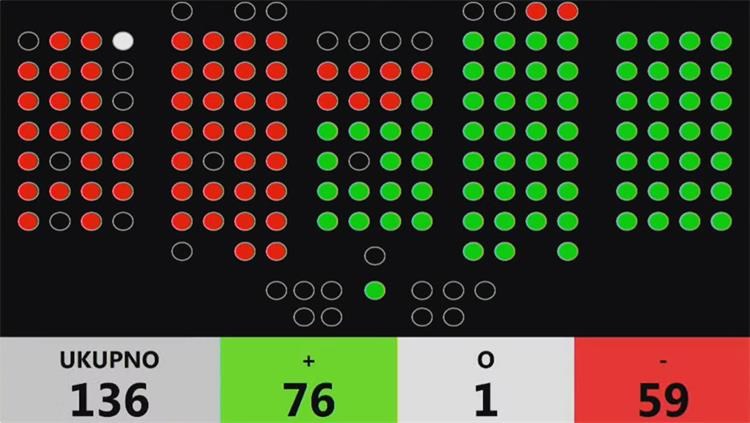
At a vote held on December 15, 2025, members of the Croatian Parliament adopted three sectoral acts – on construction, physical planning and energy efficiency in building construction.
The Parliament adopted new acts: the Building Act, the Physical Planning Act and the Act on Energy Efficiency in Building Construction.The acts will enter into force on January 1, 2026. Building permits will be issued faster, all spatial plans must be digitised, urban land consolidation principle is reinstated.
Starting from January 1, 2026, all plans will be developed digitally in ePlans. All plans will be developed according to the same standard, they will be transparent and publicly available and connected to ePermits.
The issuance of building permits shall no longer take more than 30 days, which should especially favour those building family houses. Around 90% of all building permits issued in Croatia are issued precisely for family houses.
Municipalities and cities have a three-year timeframe to adopt an urban development plan, thus responding to the investor’s prior letter of intent to enable construction on land that had been designated as building land by these units, but the construction was not possible because there was no urban development plan. If municipalities and cities do not adopt the plans in the timeframe specified, the investor - the landowner, may contact the Ministry, which then conducts a traffic study, defines the future roadway in order to construct the road and in order for the investor to obtain a building permit. The new legal solution allows investors who own the land to do it on their own, if they are financially capable, with the amount invested being deducted from the utility charges otherwise paid to the local self-government unit.
At the suggestion of the Croatian Chamber of Architects, the principle of urban land consolidation - abolished in 2014 - is now reinstated. The scope of the consolidation, which can be requested by 50% and one owner of the land, is prescribed by the local self-government unit.
Only a public investor can initiate an urban project.
Existing building areas can no longer expand as long as they include surfaces which are not equipped with basic infrastructure.
New provisions for camps and mobile homes
Housing units for affordable housing must be built in such as way as to be maximally integrated in existing settlements.
The Physical Planning Act, among other things, prescribes new provisions applicable to camps and, in turn, mobile homes.
Mobile homes are defined as “modular, prefabricated mobile houses” for the installation of which a location permit is required.
In camps located in settlements, construction works and mobile homes cannot be installed within 25 metres of the shoreline. Beyond the 25 metres, mobile homes may be installed but only up to a maximum of 30% of the total developed area. Camps are given a five-year transition period to comply with this legal provision. If camps are located outside settlement, i.e. in an isolated building area, mobile homes cannot be installed within 100 metres of the shoreline.
The Physical Planning Act also introduces a near-complete ban on condominium conversion of tourist objects, except in the zones including high class hotels.
The Building Act, on the other hand, introduces a complete digitisation of procedures through the ePermit system, the use of BIM model, faster issuance of permits and a mandatory building maintenance plan. For the first time, the Act prescribes the obligation to develop a building maintenance plan.
According to the new Act on Energy Performance in Building Construction, all buildings should be zero-emission buildings by 2050.